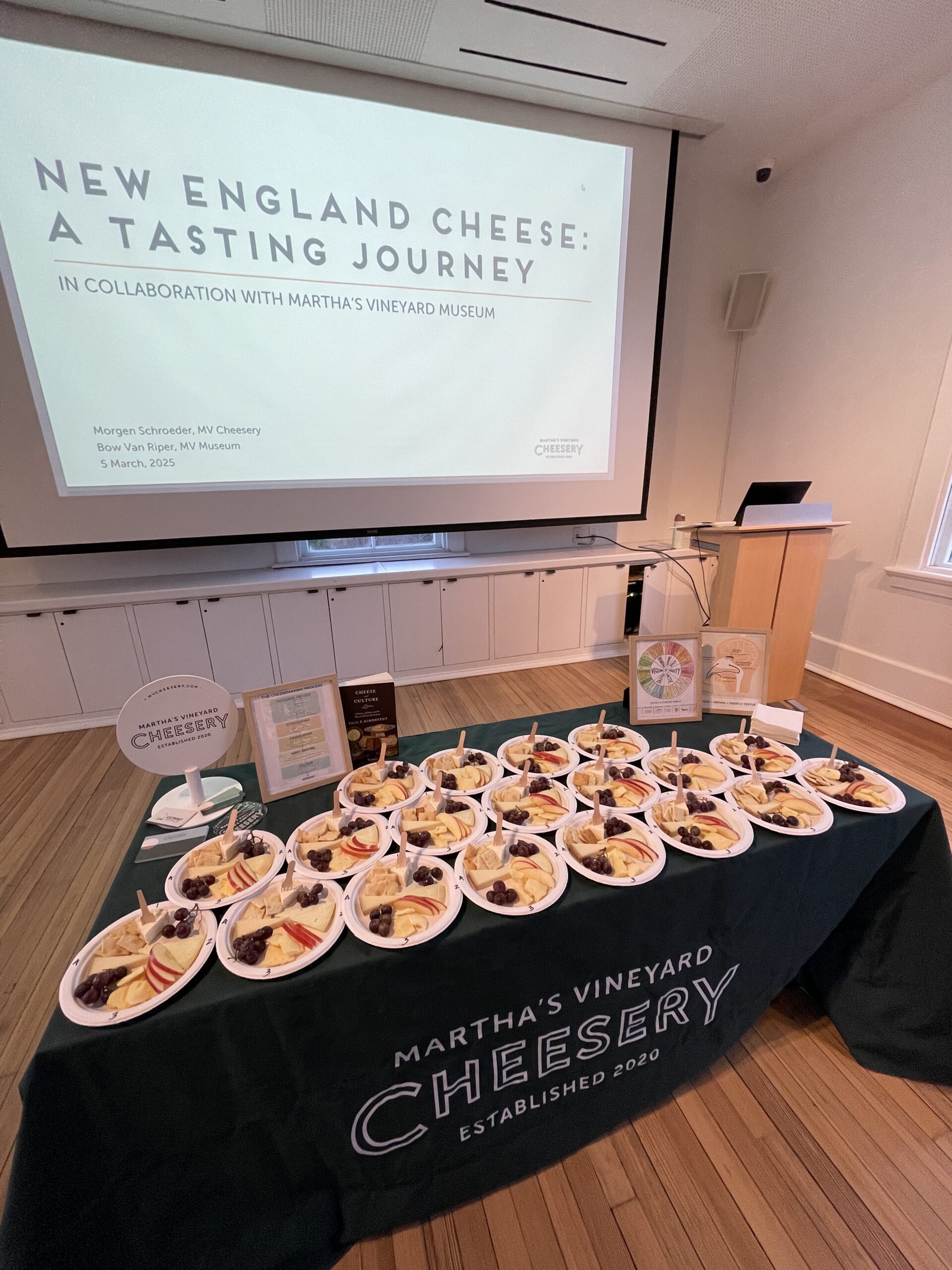
Ok cheese friends, buckle up! I’m so excited to give you all some additional details about this wonderful talk I gave last week at the Martha’s Vineyard Museum. I’m going to dive into 1. How this event came to happen, 2. Why I wanted to facilitate an event like this, 3. What source material I used to develop my presentation, and 4. A little bit of facilitation logistics / lessons learned. Hopefully this post will inspire fellow curd nerds to put themselves out there as a trusted source of cheesy knowledge in their communities. Let’s get into it!
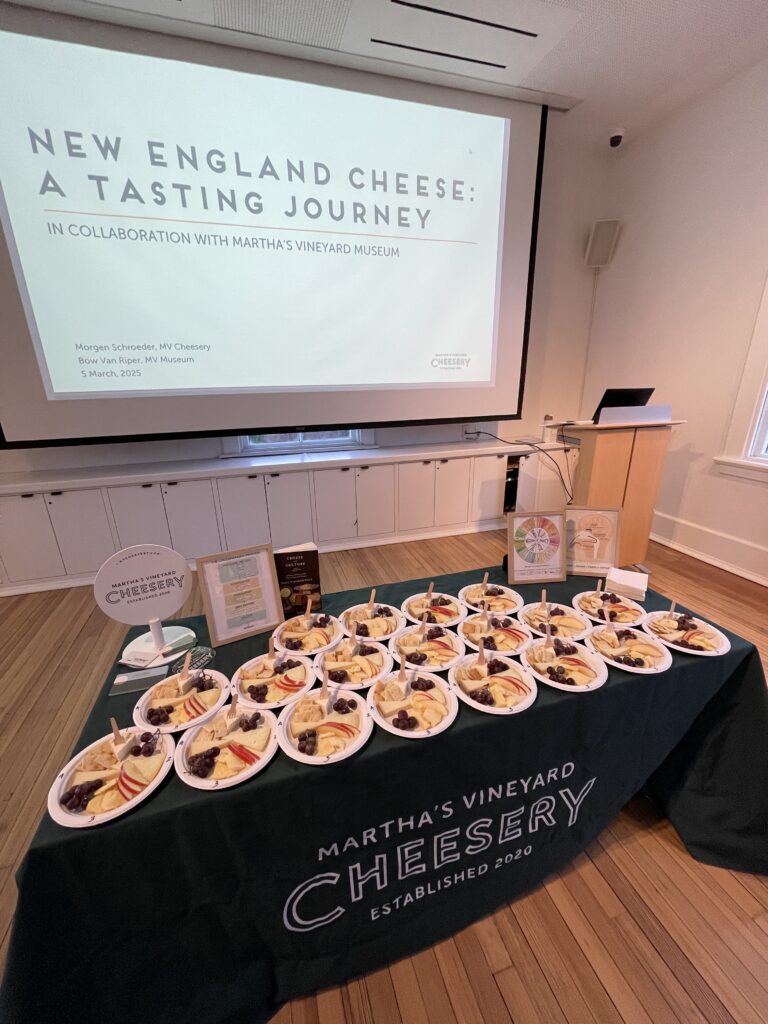
How this event came to happen?
You may have seen that I’ve given a few Cheese 101 + Tasting classes at the Tisbury Library. At the most recent class I facilitated last December, one of the attendees was Brien, who just so happens to be the Visitor Services Manager at the MV Museum. He shot me an email a few days after the class asking if I’d be interested in doing a similar event at the Museum. I answered with a resounding “YES!” and the rest is history. Moral of the story here: put yourself out there and the universe rewards you!
Why I wanted to facilitate an event like this?
Allow me to get a little bit hypothetical and historical here… so I currently find myself living on the island of Martha’s Vineyard. A place that was unknown to me until my late 20s, when I met my now husband, Alex. Alex’s mom grew up on the island and his family history here goes back a few generations. The more I learn about Martha’s Vineyard (an approximately 90 square mile island about 7 miles off the coast of Massachusetts) the more interested I become in it’s place in history.
You see, Martha’s Vineyard was one of the first locations colonized in North America, beginning around the 1620’s. The Wampanoag people inhabited the island, and the Tribe still has a presence here today. When the English colonizers made landfall, the brought with them dairy animals and cheesemaking traditions from their homeland. So it’s somewhat safe to assume that Martha’s Vineyard was one of the first places in “America” where cheese was made. I find this hypothetical thought exercise very intriguing, and I wanted to explore further.
What were my sources for my presentation?
I had a weirdly fun time compiling my research for this presentation. I was always a straight A student so giving myself an “assignment” was oddly satisfying. It also felt nice to use my ex-corporate-girlie presentation building skills for a topic that I really care about. Ok so without further ado, here are some of the information sources that I found very helpful for putting together this presentation:
🧀 The first section of my presentation was “A Very Brief History of Cheese” which covered like 10,000 years of history condensed into one slide. Hah! The two sources that I used for this were Cheese State University (CSU) and Cheese and Culture, A History of Cheese and its Place in Western Civilization by Paul Kindstedt. The former provides a wonderful 30,000 foot view while the latter goes in to very academic detail.
🧀 The next section of my presentation was “Cheese in Early New England” which zoomed in on the early colonial period. Again, Kindstedt’s book was invaluable here.
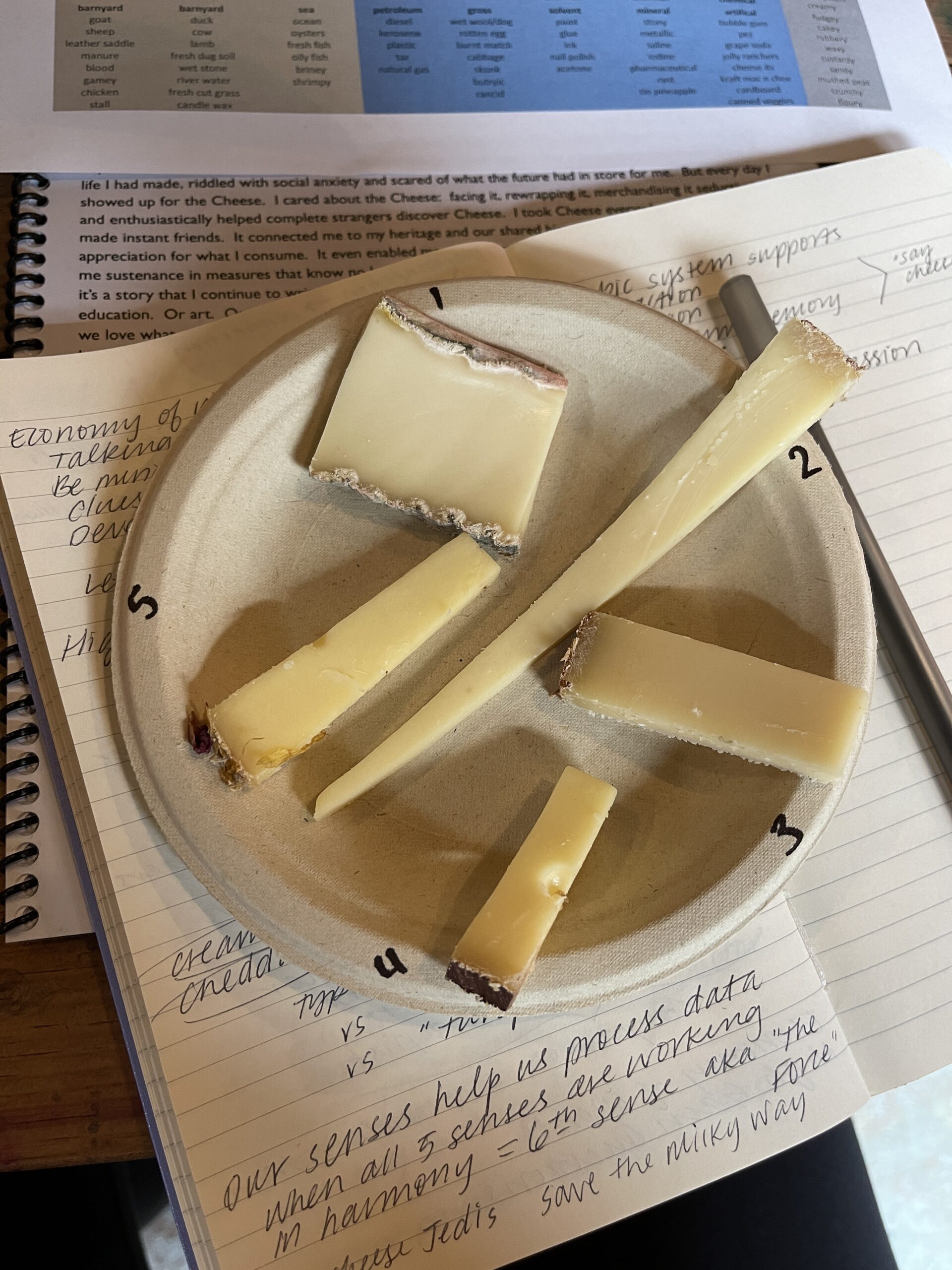
🧀 The next section was the cheese tasting interlude! I had a few slides for the “Cheese Tasting Journey”. The first slide here gave info about AROMA + TASTE = FLAVOR and I used some definitions from CSU. The second slide here gave some info about each of the four cheeses that I featured on the tasting plate. This slide was nice to leave up on the screen while people tasted and listened to the historical context interlude provided by MVM Research Librarian Bow Van Riper.
🧀 The next few slides dove into examples of Martha’s Vineyard specific dairy history. I had slides for The Barn at Seven Gates Farm and the Martha’s Vineyard Dairy Cooperative. Here’s some sources I used for these sections: Historic Seven Gates Farm Barn Demolished (Vineyard Gazette), A History of Dairy Farming on Martha’s Vineyard (Dukes County Intelligencer), Pasteurize or Certify: Two Solutions to “The Milk Problem” (realmilk.com), On the Dairy Farm (Martha’s Vineyard Magazine), Dairy Cooperative Bottle (MV Museum), This Post/Thread on the Facebook Group “Martha’s Vineyard Old Style”, and I also wanted to note that I used the forum on the Cheese State University app to ask questions to fellow cheese educators.
🧀 The final section of my presentation was “Evolution of New England Cheese” which pulled themes from Kindstedt’s book as well as my own lessons learned from participating in Cheese Monger Invitational and Jasper Hill Cheese Camp. Participating in both these in-person learning experiences was SO VALUABLE to my education and development as a cheese person and I can’t recommend them highly enough! If you have the ways and means to participate – do it!
Facilitation logistics / Lessons learned
So if you’ve made it this far into this post, maybe it’s because you want to facilitate a similar event. Hooray! You can absolutely do this. I’m going to provide a few suggestions here to help you facilitate a great event.
🧀 Planning the event: Meet with your co-organizers, preferably in person, and talk through the flow/content of your event and some of the details. Make sure you align on the following:
- Date/time/duration of the event. Include discussion of required set-up timing.
- Pricing structure of the event. I recommend having tickets available for pre-sale so that you can get a pretty solid headcount. Align on how you’re divvying up the proceeds with your co-organizer. Make sure you get this down in a post-planning session email so you don’t forget!
- Understand the space available and what tables/chairs you have at your disposal.
- Talk about how you’re going to market/promote the event.
🧀 Prepping for the event: This starts in earnest a few weeks before your event date. Work out what timing makes sense for you, here are some suggestions:
- 2 weeks before: Prep your content/materials. A presentation? A hand out? Some printed posters? Having a flavor wheel printed out to circulate around the group is always nice! I use the one from CSU.
- At least 2 days before: Acquire your cheeses/accompaniments. I account for 1oz of each cheese per person with a little extra for buffer. I like starting the process of acquiring your tasting items a few days before your event, just so you’ve got everything in hand. I’ve sourced cheeses from wholesale distributors via Catboat Coffee Co. and I’ve sourced some cheeses retail via Saxelby Cheesemongers. I usually snag all my accompaniments (fresh fruit, crackers, etc.) from Stop & Shop. Make sure you’ve got your paper plates, little forks, napkins, gloves, etc.
- At least 2-4 hours before: Prep your cheeses/accompaniments. Slice your cheeses (1oz portions), wash/slice your fruit, package it for transport.
- 1-2 hours before: Arrive on-site. Work with your co-organizer to ensure the room is set up. I like having some sort of head table where I do my plating and have a little display with my logo sign and business cards.
- 15 mins before: Plating done. Use the restroom, wash up, have some water, warm up your voice a little bit (I say this because I once suffered a crazy coughing fit during a Cheese 101 class and I literally had to excuse myself and go cough myself silly for like 5 mins before I could regain my composure). Ready for showtime!
🧀 Lessons learned: Here are some random bits and bobs that I’ve gleaned along the way:
- On finding a co-organizer: Look for community groups/institutions that do adult programming. Libraries, museums, educational orgs, school clubs, farms, event spaces, coworking spaces, company team building, restaurants, bars, wine shops, etc. So many possibilities! If it’s a non-profit or tax exempt entity, get a copy of their Certificate of Exemption for your records.
- On ticketing/headcount: I feel like I’ve been lucky and all of my various co-organizers have had their own ticketing system. Otherwise, consider a platform like Eventbrite to track your headcount. Consider having a waitlist if your event sells out. Consider capping your event at 25-30 people because any bigger than that and it starts getting less intimate and logistically tricker to execute solo.
- On cheese torture: You’ve composed an amazing tasting plate, and your attendees want to dig right in! I usually say something like “I’m going to talk for a bit and then we are going to taste through all the cheeses together. Feel free to snack on your cheeses but try to save a bite so we can all taste together!”
- On printed materials: People like handouts. They just do. I usually try to include a 1-pager that people can take home with them. If you’re going to have some handouts coordinate with your co-organizer to have a few pens on hand for the inevitable notetakers.
- On encouraging class participation: I usually say something like “I want our time together to be educational and fun. If you have a question or comment feel free to chime in!” When I’m tasting cheese, I like to say something like “Mmm I’m getting a ____ flavor, what are you guys getting?” to try and encourage people to share with the group.
- On post-event communication/feedback: I want to get better about this! If you’re trying to facilitate more events, it will be very valuable to get some attendee testimonials and feedback. Consider a way to gather people’s email addresses. Consider a feedback form or a way to collect a review, such as a Google Business Profile. Encourage people to follow you if you have a website or social media presence. Once you’ve done one event like this, it gets exponentially easier to do subsequent events, so you might as well run it back!
I’m feeling bold, so I’m going to post my full presentation for my paid subscribers (all two of you! Hi Grandma Sandy and Jordan!) on my Substack: https://mvcheesery.substack.com/